Something quiet but profound is shifting in how Britain furnishes its homes. The Circular Economy, the idea that materials should be kept in use for as long as possible, extracting maximum value before recovery, is no longer the language of policy papers and sustainability conferences. It is turning up on mantelpieces in Margate, kitchen shelves in Edinburgh, and windowsills in Bristol, in the form of something utterly unexpected: recycled iron animals.

Every time a customer picks up a Vayu Earth galvanised iron owl or a hand-welded iron giraffe, they are making a choice that the mainstream retail industry would rather they didn't, they are stepping off the linear "take, make, discard" conveyor belt entirely. This blog is the story of why that choice matters, what it means for the planet, and why reclaimed metal tabletop decoratives are not just objects of beauty but objects of principle.
"The most sustainable product is one that already exists. The second most sustainable is one made from what would otherwise become waste."

Upcycled Art: The Anatomy of a Recycled Iron Sculpture
Walk into any high-street homeware chain and pick up a small decorative animal. Notice something? It is almost certainly hollow, lightweight, and if you press a fingernail gently, slightly yielding. It is resin, or polypropylene, or some variant of the plastics family that, statistically speaking, will end up in landfill within a decade. Now pick up a Vayu Earth iron hen or iron mouse. The difference is immediate and visceral.

Tactile Heritage in Every Gram
The tactile quality of reclaimed iron is unlike anything manufactured from virgin materials. Run your fingers across the surface of a Vayu Earth iron giraffe and you will feel the honest topography of metal that has had a life before, tiny pits where galvanisation has aged into the grain, deliberate industrial welds repurposed as decorative joints, and the unmistakeable heft of solid, permanent material. This is not mass production's idea of "rustic"; it is authentically rustic, because the material genuinely has a heritage.

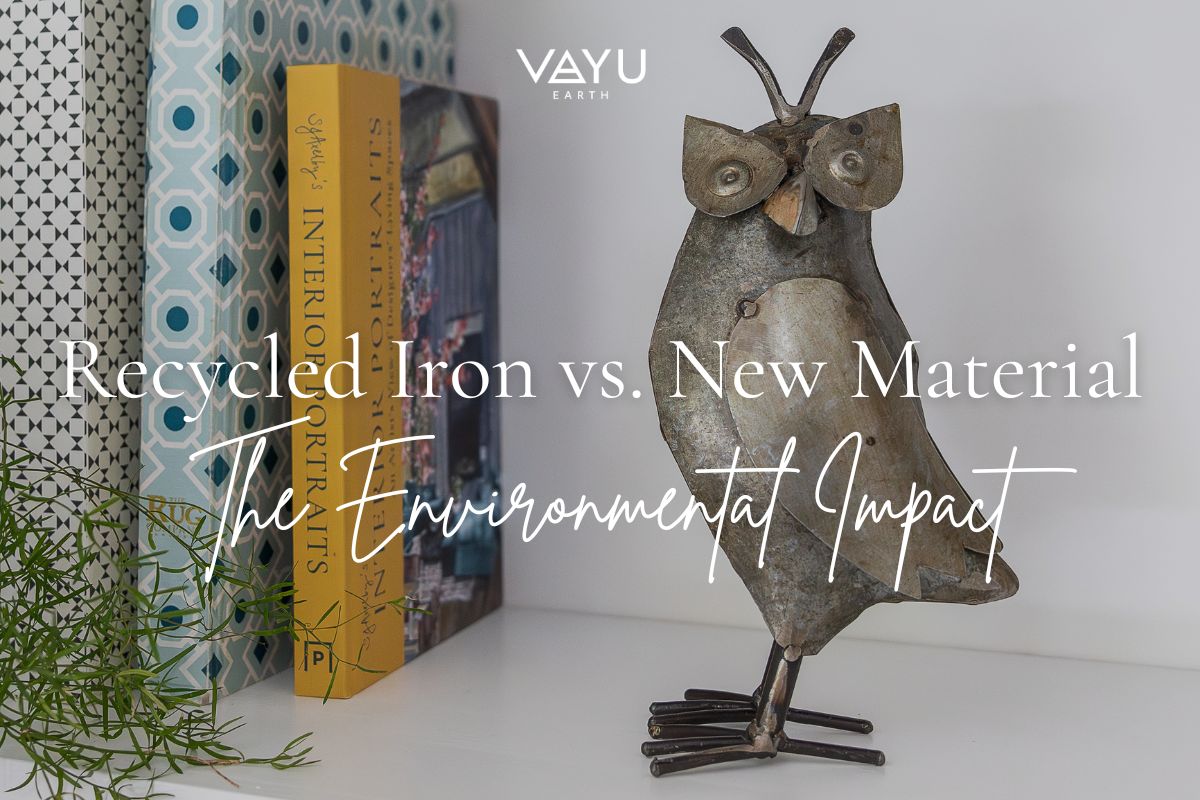
Each piece in the Vayu Earth range, the elegant iron butterfly, the stoic iron bull, the watchful iron owl, began as something else entirely. Automotive components, agricultural tooling, industrial sheeting: scrap that the economy had discarded. A craftsman's hands, and crucially, a craftsman's eye, saw something in that metal that accountants and recycling processors did not. They saw a wing. A snout. An antler. The welds are not hidden; they are celebrated, because each one is the record of a transformation.
Bespoke by Nature
In the British market, bespoke carries enormous cultural currency. We pay premiums for things that are "one of a kind," and we are right to do so, uniqueness implies care, intention, and scarcity. Vayu Earth's iron animals are bespoke in the truest, most ungamed sense: because no two pieces of reclaimed iron carry exactly the same texture, no two sculptures are identical. The iron bunny on your windowsill will have a slightly different patina, a marginally different surface story, than the one on your neighbour's shelf. That is not a manufacturing inconsistency; it is proof of authenticity.

- Surface micro-texture formed by real industrial use, not moulded artifice
- Weld lines that document the hands that made it, not a machine
- Weight distribution is unique to each piece of reclaimed stock
- Galvanised finish that will develop its own character over the years
- Provenance that no virgin material product can claim
Deconstructing Throwaway Culture: The Circular Economy in Your Living Room
Britain generates roughly 12 million tonnes of metal waste each year. A portion of that is effectively recycled back into raw material smelted down, re-rolled, and sold into the supply chain again. That process is far better than landfill, but it still consumes enormous energy. The truly elegant solution the one the Circular Economy aspires to is to skip the smelting entirely and give existing material a second purpose without destroying its current form.

That is exactly what Vayu Earth does. The iron in a Vayu Earth iron Easter bunny or iron hen is not being reprocessed into a generic ingot; it is being kept as iron, shaped by hand into something beautiful, and placed into a domestic setting where it might last a hundred years or more. Is the carbon locked into that metal during its original manufacture? It stays locked. The waste that would have required energy to process? It never gets generated.
Iron vs. "Fast Décor": A Lifespan Comparison
Consider the lifecycle of a typical resin decorative animal from a fast-fashion homeware brand. It costs little to produce because the material is cheap and the mould is reused thousands of times. It is painted often with solvent-based coatings to mimic the look of stone, wood, or metal. Within two or three years, the paint chips, the resin yellows under UV exposure, and the object is "refreshed" by being discarded and replaced. It heads to a landfill, where it will sit, essentially unchanged, for five centuries.

The Vayu Earth iron bull follows a different arc entirely. Over the first few years, it will develop a patina the naturally occurring oxidation process that the British décor world has come to cherish as a sign of quality and character. Rather than ageing towards obsolescence, it ages towards beauty. A well-maintained piece of reclaimed ironwork does not fade; it deepens. It becomes more itself, not less.
An iron sculpture doesn't become waste. It becomes an heirloom — and in doing so, it locks carbon away in your living room rather than releasing it into a landfill.

This is what it means to choose sustainable home décor with genuine conviction rather than aesthetic gesture. You are not simply buying something that looks natural; you are buying something that behaves sustainably across its entire lifespan from reclaimed source material, through hand fabrication, to decades of use in your home, with no foreseeable end-of-life waste event on the horizon.
The Ethical Gift: Eco-friendly Gifts That Tell a Story
Gifting in Britain is changing. The pile-it-high, sell-it-cheap culture of novelty gifts the kind that ends up in a drawer by Boxing Day is losing ground to a more intentional approach. Increasingly, the best gifts are those that communicate something about the giver's values, and which give the recipient a story to tell. A Vayu Earth iron owl does both.

The Artisan Element
Consider what it takes to transform industrial scrap into the outstretched wing of a iron butterfly. Each curve is not pressed by a machine following a digital template; it is persuaded by a craftsman who has learnt the language of that particular piece of metal. The welds at the joint where wing meets body are deliberate creative decisions — choosing where to allow the material's inherent character to remain visible, and where to smooth it into the form of a feather. This is upcycled art in the fullest sense: not recycling that incidentally produces something decorative, but artistry that uses reclaimed material as its medium.

When you give a Vayu Earth piece as an eco-friendly gift, you are giving all of this context along with it. You are giving the story of a material that was rescued, the skill of a craftsman who saw potential in scrap, and an object that will sit on a mantelpiece or bookshelf as a conversation piece for years. When guests ask about the iron mouse on the kitchen shelf and they will ask the owner gets to explain not just where it came from, but what it stands for. That is the kind of gift that keeps giving.
Values on Display
Britain's green living movement has matured beyond reusable coffee cups and tote bags. It is now about the longer view: the choices embedded into the fabric of a home, the objects that demonstrate a sustained commitment to living with less environmental carelessness. A Vayu Earth iron giraffe on the hearth does not shout its sustainability credentials it embodies them quietly, through its material, its weight, its visible craft, and its longevity.

Choosing these pieces as gifts says something clear: "I value craftsmanship, I value the planet, and I value the idea that beautiful things should last." In an era when the opposite disposability dressed up as convenience is the default setting of retail culture, that statement has genuine meaning.
- Tells a story: each piece has a provenance that sparks conversation
- Lasts a lifetime: iron doesn't date, chip, or fade the way synthetic materials do
- Develops character: the patina that forms over years adds soul, not age
- Zero plastic packaging: in line with Britain's single-use reduction goals
- Guilt-free luxury: beautiful, handmade, and good for the planet simultaneously
Shop the Recycled Iron Animals Tabletop Collection
Each piece is hand-fabricated from reclaimed iron. Galvanised finish. No two are identical.
Iron Owl
Watchful and wise — a symbol of knowledge crafted from reclaimed iron. Perfect for a study or library shelf.
View Product →Iron Snowman
The snowman of Britain’s winter garden rendered in bespoke reclaimed iron with natural surface character.
View Product →Iron Giraffe
Elegant silhouette, industrial soul. A striking tabletop statement that doubles as a conversation starter.
View Product →Iron Bull
Solid, stoic, and satisfyingly heavy — this is sustainable home décor with real presence.
View Product →Iron Bunny
Charming and tactile — an eco-friendly gift that any nature-lover will treasure year-round.
View Product →Iron Easter Bunny
A seasonal centrepiece with year-round credentials. Gift sustainably this spring.
View Product →Iron Hen
A kitchen classic reimagined. Reclaimed iron gives this cottage-staple genuine character.
View Product →Iron Mouse
Small in size, enormous in craft. Perfect for bookshelves, windowsills, and as a thoughtful eco-friendly gift.
View Product →Iron Butterfly
Delicate form, robust material. A testament to what artisan skill can coax from industrial scrap.
View Product →The Last Word: Sustainable Home Decor as a Political Act
Choosing a Vayu Earth iron owl over a mass-produced resin figurine is not a minor lifestyle preference. It is a small but meaningful refusal a refusal to participate in the extractive economy that mines new materials, ships them around the world in synthetic packaging, and designs them to be replaced within a few seasons. Britain has always had a streak of bloody-minded independence from trend, and an appreciation for things that are made properly and made to last. The Vayu Earth philosophy sits squarely in that tradition.

The Circular Economy doesn't require grand gestures. It requires thousands of small, consistent choices on high streets, in online baskets, and in the quiet moment of picking up an object and deciding whether it deserves a place in your home. A reclaimed iron giraffe, a hand-welded iron butterfly, a galvanised iron hen that will still be on that kitchen shelf when your grandchildren visit these are the textures of a life lived with intention.
That is what upcycled art from Vayu Earth offers: not just decoration, but declaration. Not just an object on a shelf, but a story about what we value, what we refuse to waste, and what kind of home and world we are choosing to make.