Modern Folk: How to Layer Soul into Your Home
In the fast-spinning world of 2026, where digital interfaces and automated efficiency dominate our waking hours, a quiet revolution is taking place within the four walls of our homes. The clinical, ultra-minimalist aesthetic that defined the early 2020s—often dubbed "millennial grey"—is finally being ushered out the door. In its place, a warmer, more resonant movement has arrived: Modern Folk.

This isn't just a passing interior design trend; it is a cultural response to a high-tech era. As we spend more time interacting with screens, we find ourselves craving the tactile, the imperfect, and the "heart-made." Modern Folk, or "Folk Bohemia," as it is frequently searched today, is the art of decorating with intention. it is about choosing objects that carry a pulse, a history, and a human story.
At Vayu Earth, we believe the ultimate luxury in 2026 isn't a designer label or a gold-plated fixture—it is the human touch.
The Philosophy of "Slow Craft" in a Fast-Paced World

To understand Modern Folk, one must first understand the concept of Slow Craft. Much like the slow-food movement, Slow Craft is a rejection of the "disposable" culture. It prioritises the rhythmic, traditional methods of production—weaving, carving, and hand-dyeing—over the soulless speed of the assembly line.
In a globalised market where you can order a chair and have it arrive in a cardboard box the next morning, there is something radical about owning an item that took weeks to create. When you run your hand over a Vayu Earth hand-woven cotton rug, you aren't just touching a floor covering; you are feeling the tension of the loom, the strength of the artisan’s arms, and a heritage of craftsmanship passed down through generations.
These pieces act as "grounding objects." In an age of digital ephemeralness, they offer a sense of permanence. They remind us that the best things in life require time, patience, and a steady hand.
Defining the Folk Bohemia Aesthetic

The 2026 iteration of Folk Bohemia is more sophisticated than its predecessors. It moves away from the cluttered "cluttercore" of years past and focuses instead on curated texture. It’s a joyous, soulful style that blends earthy, "moody" palettes—think artichoke greens, burnt terracotta, and deep ochre—with natural materials like raw timber, organic cotton, and heavy linen.
The goal of Modern Folk is to create a space that feels storied. It should look as though it has been gathered over a lifetime, rather than bought in a single weekend. It is about the "unfitted" look—where furniture doesn't match perfectly, but instead speaks the same visual language of craftsmanship.
How to Layer Soul: A Step-by-Step Guide
Adding "soul" to a room can feel like an abstract concept, but it often comes down to the physical layers you apply to a space. Here is how to achieve the Modern Folk look using the staples of the Vayu Earth collection.
1. Establish a Tactile Foundation

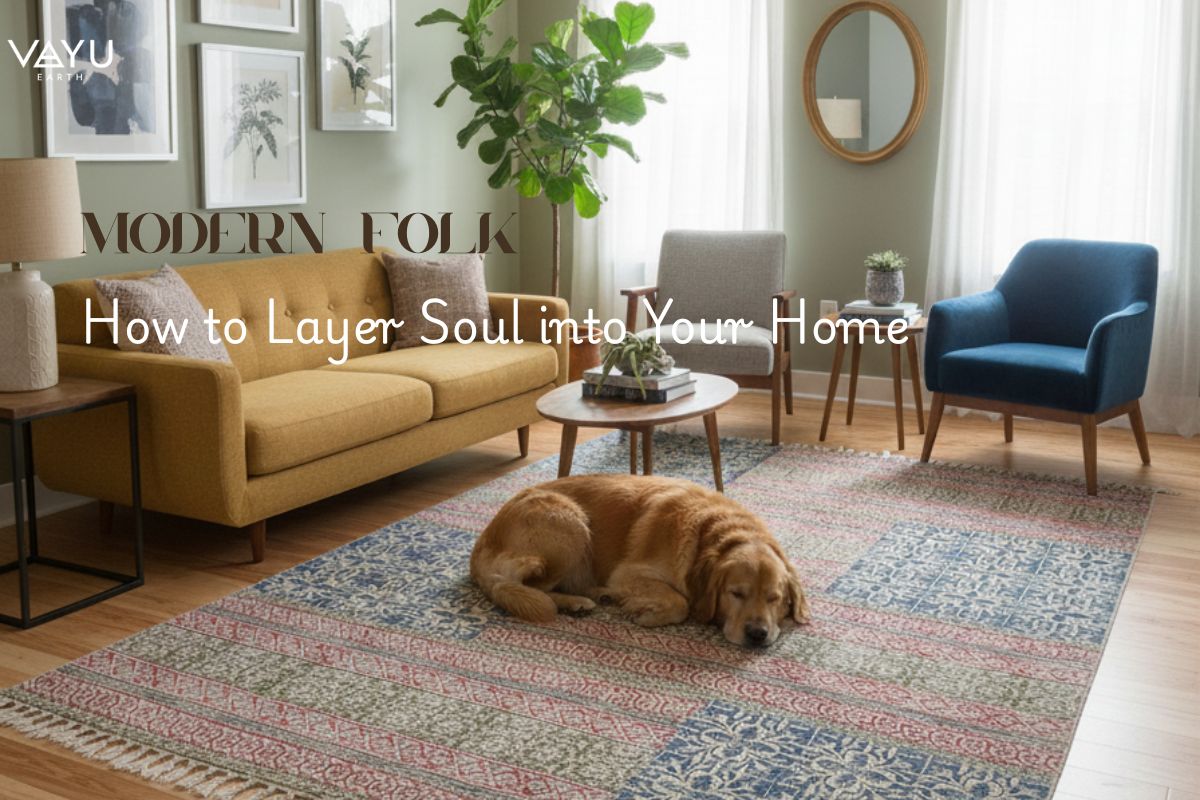
Every soulful room begins with the floor. Instead of cold, synthetic laminates or mass-produced carpets, Modern Folk calls for natural fibres. A Vayu Earth hand-woven cotton rug provides more than just a visual anchor; it provides a sensory experience.
Cotton rugs are breathable and soft, yet they carry the structural integrity of the weave. Look for rugs that celebrate "calculated imperfection"—slight variations in the weave that prove a human, not a machine, guided the thread. In a living room, a large-scale woven rug instantly softens the acoustics and makes the space feel intimate and "held."
2. The Power of "Fidget-Friendly" Textures

Modern Folk is an aesthetic that invites you to touch. One of the simplest ways to transition a sterile room into a Folk sanctuary is through the use of tasselled linen cushions.
Linen is the quintessential "heart-made" fabric; it rumples beautifully, it ages with grace, and it feels better the more it is used. By adding tassels, you introduce a playful, nomadic element that breaks up the straight lines of modern furniture. Scatter them generously. The goal is to create a "nesting" environment where comfort is the priority. When you layer different weights of fabric—perhaps a chunky pom-pom throw over a crisp linen cushion—you create a visual richness that "flat" fabrics can never achieve.
3. Introduce the Patina of Wood

If textiles are the "soft" soul of a home, wood is its "strong" soul. In the Modern Folk trend, we see a move away from highly polished, orange-toned veneers and a return to raw, hand-carved timber.
Intricate wood carvings and hand-turned bowls are essential in this look. There is a specific warmth in a piece of wood that has been shaped by a chisel. Whether it’s a decorative wall panel or a heavy wooden bowl sitting on a sideboard, these items bring a sense of the outdoors in. They carry a "patina"—a surface quality that evolves over time. In a world of plastic and chrome, the grain of a sustainably sourced piece of wood feels like a luxury.
4. The "Joyous" Palette

Folk Bohemia isn't afraid of colour, but it avoids the neon or the artificial. The 2026 palette is deeply rooted in the earth. Think of the colours found in a vegetable garden or a forest floor. Use your Vayu Earth accents to pull these colours through the room. A terracotta-toned throw or a forest-green cushion can tie a room together, making it feel organic and grounded.
Moving Beyond Mass-Produced: Why it Matters

Why are we searching so fervently for "artisan textiles" and "handmade decor" in the last fortnight? Because we are tired of the "cookie-cutter" home. When everything is mass-produced, nothing is special.
Choosing a "heart-made" piece from Vayu Earth is a conscious decision to support a person rather than a corporation. It is a decision to fill your home with objects that have a "provenance"—a known origin. This connection to the maker changes the way we perceive our belongings. We no longer see them as disposable "stuff," but as companions in our daily lives.
This shift toward the human touch is the ultimate rebellion against a world that feels increasingly automated. By layering soul into our homes, we are protecting our own humanity. We are creating sanctuaries that reflect not just a trend, but our values.