
The Plastic in Your Kitchen You Never Think About (And What to Replace It With)
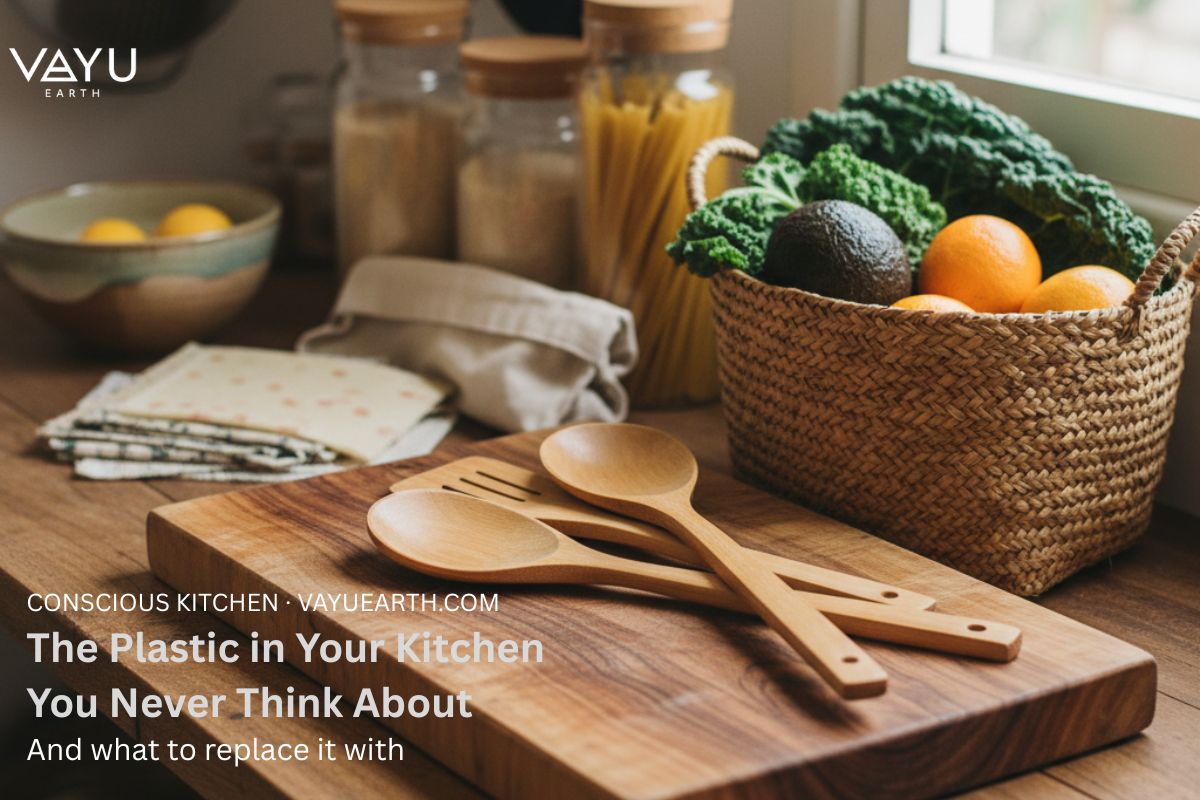
Your kitchen is probably the most plastic-filled room in your home — and most of it is invisible to you. Here's the definitive guide to identifying the hidden plastics lurking in your kitchen, and exactly what to swap them for.
The Kitchen Is Ground Zero for Plastic Exposure
If you've watched The Plastic Detox on Netflix, you'll know that one of the documentary's most startling revelations isn't about single-use water bottles or carrier bags. It's about the everyday kitchen items that we cook with, eat from, and store food in — items we've never thought to question.
Plastic chopping boards. Nylon spatulas. Melamine bowls. Cling film. Non-stick pans. The humble plastic colander sitting in your cupboard. These are the kinds of objects that share our meals, absorb heat, and — crucially — leach chemicals into the food that ends up on our plates.
The science behind this is not new, but The Plastic Detox makes it viscerally real: by reducing daily plastic contact at home, the couples in the peer-reviewed study saw measurable reductions in urinary BPA (bisphenol A) and phthalate levels in a matter of weeks. The kitchen, researchers noted, is where the most significant reductions were achieved.
So, which kitchen plastics matter most — and what can you replace them with? Let's go room by room. Well, cupboard by cupboard.
1. Plastic Chopping Boards — The Biggest Offender You're Ignoring
Let's start with the item sitting on your kitchen worktop right now. Your plastic chopping board — whether it's polyethylene, polypropylene, or a trendy flexible mat — is one of the most significant sources of microplastic ingestion in the average British home.
A 2023 study published in the journal Environmental Science & Technology estimated that plastic chopping boards could shed anywhere between 14 and 71 million microplastic particles per year into food, depending on the knife used and how worn the surface is. Older, scratched boards are significantly worse — those grooves and cuts are where plastic fibres accumulate and break free.
And here's the thing: you can't wash microplastics away. Once they're in your food, they're in your food.

🪵 The swap: A solid hardwood chopping board — acacia, albasia, or teak — contains no synthetic materials and sheds nothing. Hardwoods also have natural antibacterial properties, meaning they're actually safer than plastic for food preparation. Our handcrafted albasia wood chopping boards at Vayu Earth are made by skilled artisans and designed to last a lifetime with simple oiling.
2. Nylon and Melamine Kitchen Utensils — The Silent Leachers
Take a look in your utensil drawer. If you see a nylon slotted spoon, a melamine spatula, or a plastic ladle — especially one that's discoloured, warped, or has been used regularly with hot food — you're looking at a daily source of chemical exposure
Nylon (polyamide) and melamine-formaldehyde resins are widely used in kitchen tools because they're cheap and heat-resistant. But 'heat-resistant' is not the same as 'inert'. When plastic utensils are used in hot pans, they can release melamine, formaldehyde, and primary aromatic amines (PAAs) — chemicals that have been associated with kidney damage and are classified as potentially carcinogenic.
The risk compounds over time: scratched, stained, or older utensils leach at far higher rates than new ones. If your spatula has seen better days, it has almost certainly seen better chemistry too.

🎋 The swap: Bamboo and solid wood kitchen utensils are the most straightforward replacement — they're durable, naturally antimicrobial, and don't leach anything into hot food. At Vayu Earth, our bamboo kitchen utensil sets are hand-finished and built for proper cooking, not just occasional stirring.
3. Plastic Food Storage Containers — Especially When Heated
This one will make you think twice about last night's leftovers. Plastic food storage containers — Tupperware, clip-lock boxes, zip-lock bags, and the takeaway tubs so many of us hoard under the sink — are a significant source of BPA, BPS, and phthalate exposure, particularly when used in the microwave or dishwasher.
Even containers labelled "BPA-free" aren't necessarily safe. Research from the University of Texas found that many BPA-free plastics actually leach BPS (bisphenol S), which behaves similarly to BPA in the body and disrupts hormonal function. 'BPA-free' is a marketing claim, not a safety guarantee.
The combination of heat + fat + time is particularly problematic. Hot, fatty foods — lasagne, soup, leftover curry — are especially effective at drawing plastic chemicals out of containers and into your meal.

🫙 The swap: Glass jars and containers are the gold standard for food storage — inert, non-leaching, and infinitely reusable. For dry goods like bread, fruit, and vegetables, seagrass and wicker storage baskets offer a beautiful, breathable, and entirely plastic-free alternative. Vayu Earth's hand-woven seagrass baskets keep produce fresher for longer and look considerably more stylish than a stack of Tupperware.
4. Cling Film — A Thin Layer of Trouble
Cling film (or plastic wrap) is one of those kitchen staples so ubiquitous that questioning it feels almost radical. But it's worth noting: most cling film is made from PVC (polyvinyl chloride) or LDPE (low-density polyethylene), and can contain plasticisers — chemical additives including phthalates — that help make it stretchy and clingy.
These plasticisers can migrate into food, especially when in contact with fatty foods like cheese, meat, and cooked dishes. The EU has restricted several plasticisers in food-contact materials, but the regulation is complex and not always clearly communicated on packaging.

🍋 The swap: Beeswax wraps, natural cotton bowl covers, linen bread bags, and glass lids are all excellent alternatives. For most everyday uses — covering a bowl, wrapping half an avocado, keeping bread fresh — a damp cotton cloth or a plate placed on top of a bowl works just as well as cling film ever did.
5. Non-Stick Cookware — The PFAS Problem
Non-stick pans coated with PTFE (polytetrafluoroethylene) — commonly known as Teflon — are one of the most widely used forms of plastic in British kitchens. And while the coating itself is relatively stable at low temperatures, it begins to break down above 260°C — a temperature easily reached when preheating an empty pan.
More significantly, older non-stick cookware and some budget brands may still use PFOA (perfluorooctanoic acid) or related PFAS ('forever chemicals') in their manufacturing process. PFAS are so named because they don't break down in the environment or in the body — and have been linked to thyroid disruption, immune system effects, and certain cancers.
Even if your pan is PFOA-free, a scratched or flaking non-stick surface is releasing microplastic particles directly into your food.

🍳 The swap: Cast iron, stainless steel, and carbon steel pans are the long-term investment your kitchen deserves — they improve with use, last for generations, and leach nothing. For baking, unglazed ceramic and stoneware bakeware are naturally non-stick when properly seasoned and free of any synthetic coatings.
6. Plastic Colanders, Strainers, and Washing-Up Bowls
These are the forgotten plastics — the ones at the back of the cupboard or sitting permanently by the sink. Plastic colanders, strainers, mixing bowls, and washing-up bowls are typically made from polypropylene or ABS plastic, both of which can leach chemicals when in contact with hot water or acidic foods.
Pouring boiling pasta water through a plastic colander? That combination of heat, steam, and direct food contact creates ideal conditions for plastic migration — yet it's something millions of British households do every evening without a second thought.
🌿 The swap: Stainless steel colanders and mixing bowls are affordable, durable, and completely inert. Bamboo steamers and natural fibre straining bags are beautiful alternatives for specific tasks. And for the washing-up bowl — a simple stainless steel basin lasts decades and doesn't harbour bacteria in scratches the way plastic does.
Your Complete Kitchen Plastic Swap Guide
Here's a quick-reference table of the most common kitchen plastic offenders, their natural alternatives, and the Vayu Earth products that fit the bill:
|
❌ Swap out |
✅ Swap in |
Vayu Earth pick |
|
Plastic chopping board |
Solid wooden board |
Albasia wood chopping board |
|
Nylon / melamine utensils |
Bamboo or wooden tools |
Bamboo kitchen utensil set |
|
Plastic storage containers |
Glass jars + wicker baskets |
Hand-woven seagrass basket |
|
Cling film / plastic wrap |
Beeswax wraps + linen covers |
Natural cotton bread bag |
|
Non-stick coated pan |
Cast iron / stainless steel |
Handmade ceramic bakeware |
|
Plastic colander |
Stainless steel or bamboo |
Bamboo steamer / strainer |
|
Plastic salad spinner |
Linen salad bag or bowl |
Hand-thrown ceramic bowl |
|
Plastic dish brush |
Natural fibre / wooden brush |
Coconut husk scrubber |
Why Natural Materials Are Better — Not Just Safer

It's easy to frame plastic-free living purely through the lens of health risk — and the science absolutely supports doing so. But there's a deeper reason to make the switch, one that The Plastic Detox only touches on: natural materials are simply better to cook with
A solid wooden chopping board feels different under a knife. A hand-thrown ceramic bowl holds heat differently to a plastic one. A seagrass basket breathes in a way that keeps fruit fresher. These aren't just aesthetic differences — they're functional ones, rooted in the way natural materials interact with food, air, and temperature in ways that synthetic plastics simply cannot replicate.
And then there's the longevity argument. A good hardwood chopping board, properly cared for, will outlast thirty plastic ones. The seagrass basket you buy today could still be in your kitchen in twenty years. When we account for the full lifetime of an object — its production, use, and disposal — natural materials almost always win on every metric that matters: environmental impact, durability, and cost per use.
The Vayu Earth Kitchen — Made by Hand, Free from Plastic

At Vayu Earth, everything in our kitchen and homeware collection is made from natural, sustainably sourced materials by artisan communities across South and Southeast Asia. Our wooden kitchenware, seagrass storage, bamboo utensils, and hand-thrown ceramics are crafted without synthetic coatings, plastic components, or harmful chemical treatments.
Every piece is made to last — not just because we believe in quality, but because we believe that the antidote to a throwaway culture is objects worth keeping. Beautiful things, made honestly, by people who are paid fairly for their skill.
That's what the plastic-free kitchen looks like in practice. Not clinical. Not compromise. Just craftsmanship over chemistry
Frequently Asked Questions
Is a wooden chopping board really more hygienic than a plastic one?
Yes — and this surprises many people. Research from the University of California found that bacteria drawn into the wood grain of a hardwood board died off rapidly and were not recoverable after a few minutes, whereas bacteria in the cuts of plastic boards multiplied. Hardwood has natural antimicrobial properties. A plastic board, once scored with knife marks, is almost impossible to sanitise properly.
What about BPA-free plastic — isn't that safe?
Not necessarily. 'BPA-free' means the product doesn't contain bisphenol A, but many BPA-free plastics use alternative bisphenols (BPS, BPF) that behave similarly in the body. The precautionary principle suggests avoiding all bisphenol-based plastics for food contact, particularly with hot or fatty foods. Glass, ceramic, and natural materials carry no such concern.
How do I clean a wooden chopping board?
Wash with warm soapy water immediately after use, rinse, and stand on its edge to dry — never lay flat, which traps moisture and causes warping. Once a month, rub with food-grade mineral oil or beeswax to condition the wood and prevent cracking. Never put it in the dishwasher.
Are seagrass baskets food safe?
Seagrass baskets are ideal for storing dry goods, bread, fruit, and vegetables — anything that doesn't require refrigeration or moisture resistance. They're not suitable for wet or liquid storage. Use glass jars for anything damp, and seagrass for dry, breathable storage where air circulation is beneficial.
Where do I start if I can't replace everything at once?
Start with the highest-impact items: your chopping board (used daily with a knife) and your food storage containers (especially if you microwave in them). These two swaps alone will meaningfully reduce your daily plastic exposure. Everything else can follow gradually, as items need replacing.
Ready to Transform Your Kitchen?
Explore the Vayu Earth kitchen and homeware collection — thoughtfully made, entirely plastic-free, and crafted by artisans who care as much about quality as you do about what goes into your food.
Shop wooden kitchenware. Shop seagrass storage. Shop bamboo utensils. Make your kitchen a place where the materials are as good as the meals.





)